
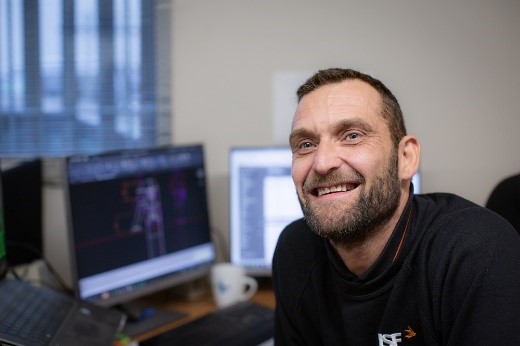
You joined ISF in 2005 as a designer. How has your role changed since then, and what does it involve now that you’re on the senior leadership team?
When I joined ISF in 2005 as a 23-year-old designer, my role was focused on producing general arrangement and detailed drawings for manufacture. At the time, I worked under a project manager while continuing to develop my knowledge of manufacturing processes and the physical capabilities of the fabrication and process engineering industry.
Over the years, I progressed into a project management role and began running smaller projects within the business. As my experience grew, those projects increased in size, and I now manage projects ranging from £1,000 to £750,000.
I’m now a member of the senior management team, so I have stepped back from the detailing process to take an active role in the day-to-day business operations and managing the projects under my control.
In my current role as Senior Project Manager, I complete extensive site surveys nationwide, prepare general arrangement and proposal drawings for review, confirm technical specifications to suit customers’ requirements, and plan project installations and programmes of works.
I liaise between customers and third-party contractors, including electricians, pipework specialists, equipment suppliers, structural engineers and civil engineers. I also manage installation services, including plant hire, health and safety documentation, accommodation, and the shipping of goods and site teams when completing work in Northern Ireland.
Alongside my project management responsibilities, I also support general business operations. This includes taking sales enquiries, preparing quotations, attending management review meetings and supporting their implementation, and contributing to internal health and safety & quality review meetings.
What first drew you to engineering, and how did you end up specialising in feed mill design?
I’ve always been interested in mechanics.
From a young age, I had a strong interest in engineering and mechanics. As a teenager, I owned dirt bikes and spent weekends riding and working on them with friends.
After high school, I enrolled in a Mechanical Engineering NVQ Level 3 at York College, where I was encouraged to progress to the advanced NVQ Level 4 qualification. During that course, we covered 2D AutoCAD design, and I was awarded Engineering Student of the Year at the original York Technical College.
After completing my NVQ Level 4, I completed a night course in computer-aided design while also working in a short-term general factory role. During the course, MRC Process Technology, a feed milling design and installation company, contacted the college looking for potential new design apprentices. I was put forward for the opportunity, which led me to work at MRC and later complete an HNC in Mechanical Engineering.
Later, I moved to ISF after learning that the company worked in the same field of engineering and had much more to offer.
What project are you most proud of, and why does it stand out?
In 2010, I completed a large transfer system project for a feed mill in Scotland. The project involved designing and manufacturing a conveying system that transferred animal feed directly from the mill to a recently constructed chicken farm located a considerable distance away.
The project included manufacturing two huge steel structures. The first structure allowed the conveying equipment to exit the factory at a high level and travel across the site without interfering with existing vehicle operations. This was an important part of the design, as the system needed to pass over the site while allowing normal site movements to continue.
The conveying system consisted of seven chain-and-flight conveyors, covering approximately 160 metres in total and delivering material to eight storage silos. We also manufactured a second steel structure to provide high-level access to the silos and support a belt-and-bucket elevator.
The installation required large padstones for the gantry structures, along with around 20 smaller padstones spaced across the site to support the conveying equipment. Civil contractors worked to our details as part of the wider project.
Given the size and scale of the job, it was extremely satisfying to see the finished system in place, travelling across the landscape. It was particularly rewarding to know I had personally surveyed, designed, and detailed all the mechanical components supplied for the project.
What’s kept you at ISF for 20 years?
ISF has always been a friendly and supportive place to work. Many employees have been with the company for a long time, and as a family-run business, there’s a real sense of community as we have all grown and developed together over the years.
The company has also encouraged progression from within, giving me the opportunity to continue developing my career without needing to look elsewhere. That long-term support and opportunity for growth have been an important part of my journey with ISF.
What’s the best bit of advice you’d give someone starting in engineering or design?
Always put yourself in the end user’s shoes. Review your designs and make sure they’re as user-friendly and serviceable as possible.
Outside of work, how do you switch off?
Given the nature of our business, with project installations usually happening during weekends, it’s almost impossible to switch off totally. As project managers, we are always available by phone to address any questions that may arise during the installation phase, allowing the project to proceed smoothly. However, I do enjoy spending time with my young family, going on family bike rides, taking them swimming and having fun days out. I also enjoy snowboarding & socialising with friends.